Cartizol Collagen Injection

A new biological injection for knee osteoarthritis: purified type I atelocollagen placed in the joint to relieve pain and, with it, supplement the worn cartilage matrix and support the joint's own repair environment. A biological option with regenerative potential, offered where assessment finds it suitable. No referral required.

15-minute visit
No referral
Biological collagen

Collagen as a Scaffold for the Joint

Cartizol is a purified type I atelocollagen in an injectable gel. Atelocollagen is collagen with the end segments (telopeptides) that can trigger immune reactions removed, which is why it is used in implantable and injectable medical products.

  • Supplements the cartilage matrix — type I collagen is deposited onto the worn joint surface, where it is thought to act as a temporary scaffold.
  • Supports cartilage cells — laboratory and animal studies show chondrocytes attach to and multiply on the collagen scaffold, and inflammatory signalling in the joint lining is dampened.

Cartizol is often described as a regenerative injection, and that is where its interest lies: beyond relieving pain, laboratory and animal studies show collagen supports cartilage-cell activity and calms inflammation in the joint lining. Trials to date measure symptom relief rather than regrown cartilage, and the evidence base is newer than for hyaluronic acid, so we present it as a promising option alongside the established ones rather than a replacement for them.

Who Cartizol Is For

Good candidates

  • Mild-to-moderate knee osteoarthritis (Kellgren-Lawrence grades 1–3) with pain that limits daily activity
  • Patients for whom a corticosteroid injection is unsuitable (for example, with poorly controlled diabetes)
  • Patients who have had a reasonable response to hyaluronic acid and want a comparable alternative with regenerative potential
  • People looking for an injection that may support the cartilage surface as well as relieve pain

Less suitable

  • Known allergy to porcine (pig-derived) collagen or other collagen products — Cartizol is porcine-derived
  • Active joint infection or skin infection over the knee — always excluded before any joint injection
  • Advanced (grade 4) osteoarthritis, where a surgical opinion is usually the more useful next step
  • An acutely inflamed, swollen knee needing fast relief — a corticosteroid or Cingal injection usually suits that situation better

Current Evidence for Collagen Injections

Collagen injections for knee osteoarthritis have been studied in randomised trials and observational series over the past decade. In brief:

  • Versus placebo: a double-blind randomised trial of intra-articular type I atelocollagen (Cartilage, 2021) reported better pain relief than a saline injection.
  • Versus hyaluronic acid: a 2025 comparison of two injection cycles six months apart (In et al., Bioengineering, 40 patients) found collagen non-inferior to hyaluronic acid for pain and function, with a similar safety profile.
  • Other collagen products: an earlier study of a polymerised type I collagen reported greater pain reduction than hyaluronic acid at six months (Furuzawa-Carballeda et al.), although that is a different formulation from Cartizol.
  • Hydrolysed collagen versus hyaluronic acid: a 2025 retrospective study of a hydrolysed-collagen product (Heredia Sulbaran and Gomez, BMC Musculoskeletal Disorders; 72 patients) reported greater improvement in pain and function at 12 months than a single hyaluronic acid injection, though with unequal dosing (three collagen injections versus one) and no randomisation. It is a different formulation from Cartizol.
  • Safety: a retrospective review of 91 patients given repeat atelocollagen injections reported pain relief in most, with no serious device-related adverse events. The usual side effect is mild soreness for a few days.

A larger randomised trial comparing collagen with hyaluronic acid is registered and ongoing. We will update this page as results are published.

How Cartizol Is Designed to Work

The points below are summarised from the manufacturer's product information and the studies it cites. They describe the product's intended mechanism and the published trial results; they are not a promise of outcome. Your doctor will advise whether Cartizol is suitable for your knee.

Supplements the protective surface layer

Cartizol is applied to damaged articular cartilage to supplement the lamina splendens, the thin type I collagen layer on the cartilage surface. The manufacturer describes this layer as helping to retain chondrocytes and proteoglycans, which are lost as osteoarthritis progresses.

Reduces surface friction

By supplementing that surface layer, Cartizol is intended to reduce friction between the joint surfaces and to provide boundary lubrication, which may ease pain on loading.

Reinforces the collagen structure

The manufacturer reports that Cartizol reinforces the collagen network in damaged cartilage and encourages the tissue's own collagen synthesis, which in laboratory models was associated with cartilage recovery.

Published evidence cited by the manufacturer

  • Preclinical model. In a rabbit model of cartilage defects, cartilage-thickness scores in the atelocollagen group were closer to normal than in the control group at 12 weeks (reported p = 0.0257), with histology showing restored collagen type I and type II staining.
  • Clinical trial. A double-blind, randomised, placebo-controlled trial of intra-articular type I atelocollagen for knee pain enrolled 200 patients with Kellgren-Lawrence grade I to III osteoarthritis across five Korean university hospitals (101 received Cartizol, 99 received saline) and followed them for 24 weeks.
  • Pain scores. On a 100-mm visual analogue scale, mean pain fell from 62.05 to 32.11 in the Cartizol group and from 60.51 to 41.14 in the placebo group at week 24 (reported p = 0.0147). A larger share of Cartizol patients reached a 20% improvement (p = 0.0150) and a 40% improvement (p = 0.0239).
  • Safety. Over the 24-week follow-up, the rate of adverse events did not differ significantly between the two groups, and the events reported resolved with conventional treatment.

Regulatory and technology background

  • Raw material listed in a US FDA Drug Master File
  • Assessed under Korea's New Health Technology Assessment (nHTA)
  • New Excellent Technology (NET) certification from Korea's Ministry of Health and Welfare
  • US and European patents for its aseptic collagen manufacturing method

These findings come from one manufacturer-cited randomised trial and preclinical work. Individual responses vary, and collagen injection is one of several options we may discuss with you.
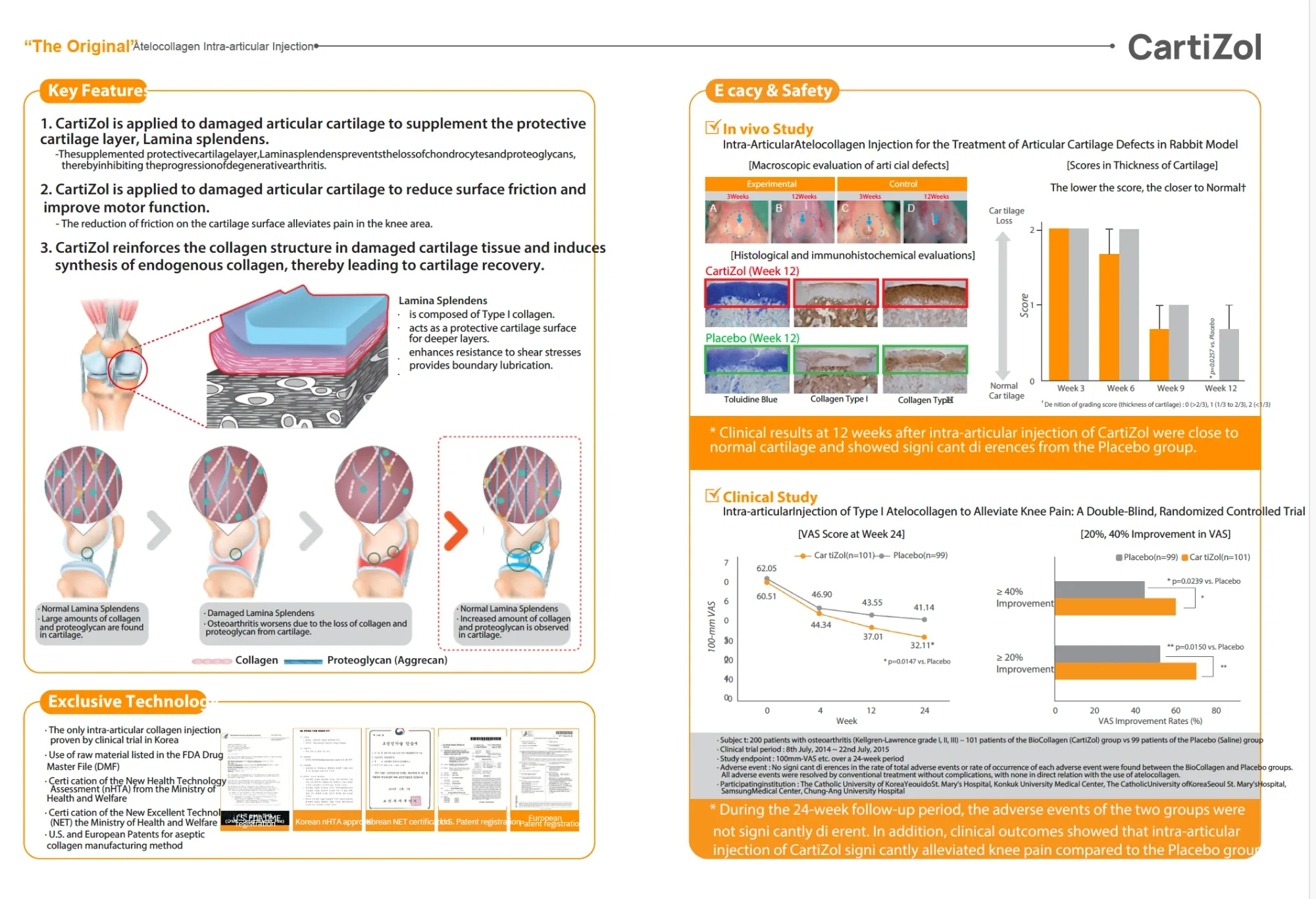
CartiZol information sheet: key features, in vivo study, clinical study and certifications
Manufacturer's information sheet for CartiZol atelocollagen intra-articular injection. Tap to open at full size.

What to Expect on the Day

  1. Assessment. The doctor confirms the diagnosis, grades the osteoarthritis from your history, examination and any imaging, and discusses which joint injection is suitable for you.
  2. Consent. We explain what the product is, its porcine origin, what the trials show, the usual side effects and the alternatives.
  3. Injection (5–10 min). Skin sterilised, joint identified, Cartizol delivered under sterile technique. Ultrasound guidance is used where it improves accuracy.
  4. Post-injection. Mild soreness for 3–4 days is common. Avoid heavy loading of the knee for 48 hours; light walking is fine.
  5. Follow-up. A review at about 6 weeks to assess your response. A second injection can be considered after 6 months, in line with the repeat cycles used in the studies.

How to book

No referral required. Walk in during opening hours or book online — the assessment and, where suitable, the injection are usually done in the same visit.

A note from our clinicians

Cartizol is a reasonable option for a mild-to-moderate osteoarthritic knee when a patient is interested in a biological injection and is comfortable with the evidence for a newer product. It is not a cure, and we do not recommend it for a knee that is acutely inflamed or at end stage. We lay out the evidence as it stands and let you decide alongside the other joint injections we offer.

Common Questions About Cartizol

No. Oral collagen is digested into amino acids and has, at best, an indirect effect on joints. Cartizol is placed directly inside the joint, where the collagen stays in contact with the cartilage surface for a period.

Studies have reported improvement persisting over follow-up periods of several months; the comparison with hyaluronic acid repeated the injection at six-month intervals. Individual responses vary. We review you at about six weeks, and a second injection can be considered after six months.

The most direct comparison, a 2025 study of two injection cycles (In et al., Bioengineering, 2025), found collagen non-inferior to hyaluronic acid for pain and function, with a similar safety profile — so you can expect at least comparable relief. An earlier study of a polymerised type I collagen product reported greater pain reduction than hyaluronic acid at six months (Furuzawa-Carballeda et al.), and a larger randomised trial of collagen versus hyaluronic acid is under way. The choice usually comes down to your diagnosis, your preferences and cost.

Mild soreness and stiffness for a few days are the most commonly reported. As with any joint injection there is a small risk of infection, bleeding or an allergic reaction. Cartizol is porcine-derived, which matters for people with pork-product allergies and is a consideration some patients wish to weigh; we raise it beforehand.

Ready to discuss a Cartizol injection?

Book online, use the enquiry form, or walk in during opening hours.